
Announcing CODA’s Multi-System Research Model for Complex Disorders
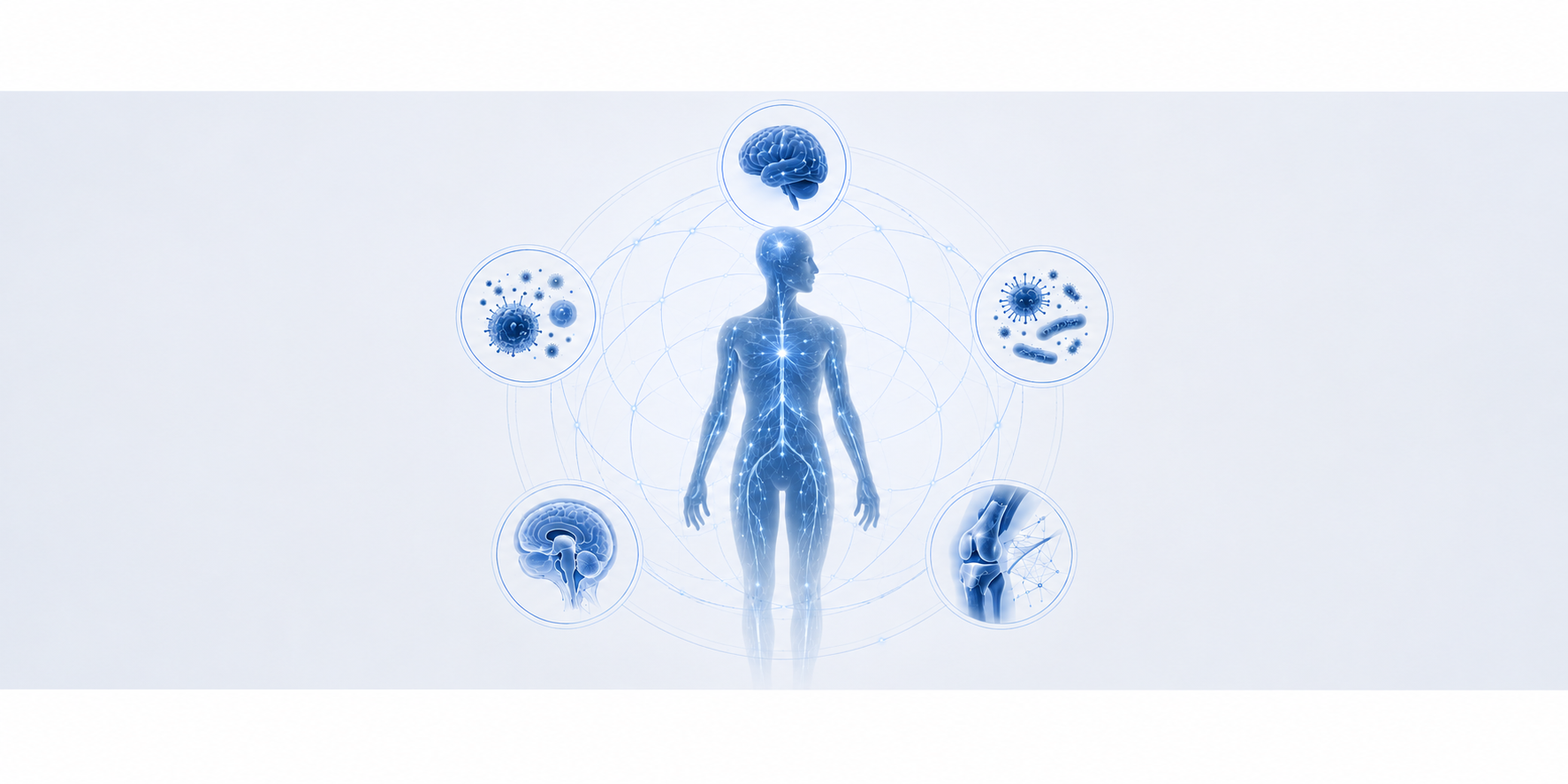
Following an extensive review of the neuroimmune research landscape, we identified five integrated scientific domains and the leading researchers advancing them.
For decades, patients living with complex chronic diseases have navigated medical and research systems built around separation.
But these patients do not experience disease in fragments. And many patients living with complex chronic disease do not get sick one system at a time. In fact, it’s just the opposite. Their illness affects multiple parts of their bodies at once. Patients experience a cascade of life-altering symptoms that appear to have no beginning or end.
Importantly, many patients also do not fit neatly into a single diagnosis. They carry many, some receiving 4 or 5 different names: Long COVID, ME/CFS, POTS, EDS/HSD, MCAS, chronic migraine, endometriosis, IBS and more.
So, we asked. What if these symptoms and diagnoses were never entirely separate to begin with?
What if the connection between them is where the answers actually exist?
Because if these illnesses involve interconnected systems and converging mechanisms, studying them in isolation may limit our ability to fully understand them.
That is CODA’s premise. To advance treatments and cures for these patients, we study the whole patient. We have developed a systems-level research model designed to study illness the way patients actually experience it.
A new model has emerged. But first, let me share with you how we got here.
To Know Where We’re Going,
We Needed to Start With Where We Are
Over the past year, we conducted an extensive review of the neuroimmune research landscape to understand where the greatest opportunities may exist across complex chronic disease.
We already knew important research existed. Here’s what else we found:
Decades of scientific discovery still weren’t reaching doctors and patients fast enough.
Scientists were conducting important work, but it wasn’t being coordinated and funded at scale.
Breakthroughs happening in other diseases were showing relevance to complex chronic illness.
Patients were still being grouped by symptom and diagnosis, highlighting the need for further subtyping and more precise treatments.
Matching the right treatments to the right patients remained one of the most elusive problems to solve.
And then we got to the best part.
Instead of focusing narrowly on individual diagnoses, we explored emerging science across interconnected biological systems. The deeper we looked, the clearer it was that science was rooted in connection.
Researchers studying autonomic dysfunction were uncovering relationships tied to vascular regulation and cerebral blood flow. Investigators exploring inflammatory signaling were identifying effects on cognition, sensory processing, and neural function. Scientists studying connective tissue and craniocervical dynamics were observing interactions involving autonomic regulation and immune dysfunction.
That became foundational to CODA’s research strategy and ultimately led to five integrated scientific domains representing some of the most biologically interconnected areas of neuroimmune investigation today.
Focusing on the Whole Patient:
CODA’s 5 Neuroimmune Research Areas
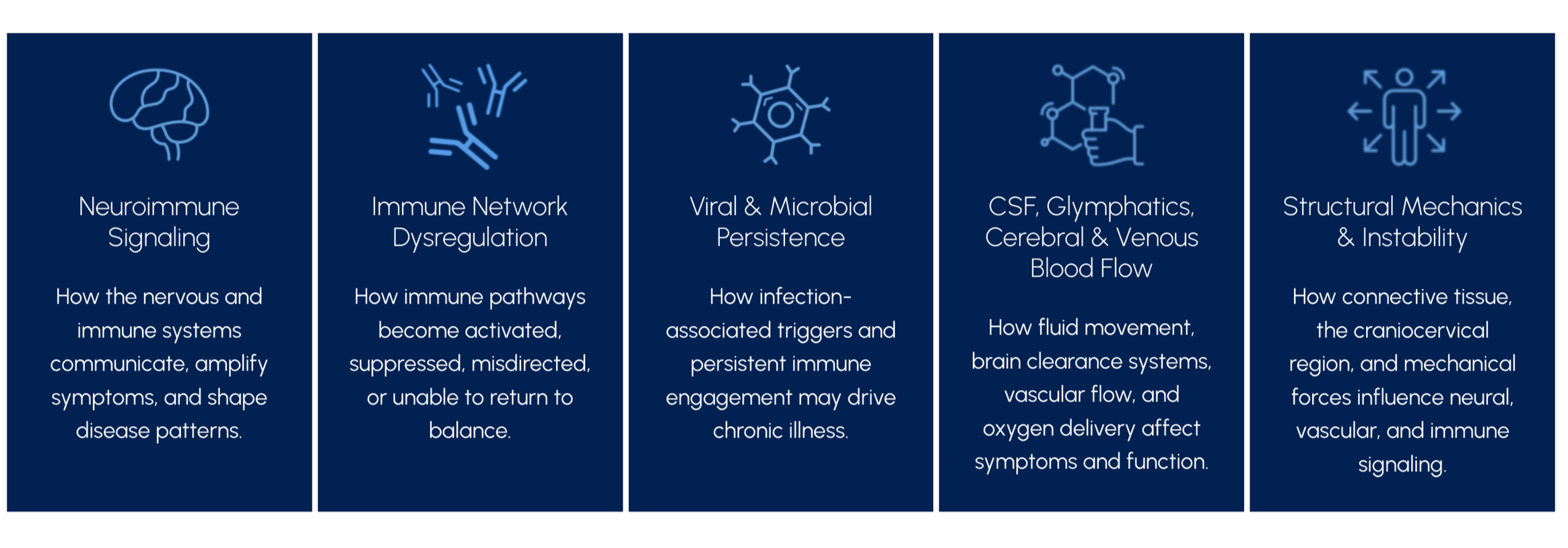
These 5 domains reflect the interconnected systems and mechanisms that may influence one another continuously throughout the body. Together, they form the foundation of CODA’s systems-level research model for complex chronic disease.
1. Neural and Autonomic Signaling and Circuit Dysregulation: Disturbances in central neural and autonomic circuits, sensory processing, and salience networks can drive persistent dysregulation, impaired homeostasis, and amplified pain and sensory responses.
2. Immune Network Dysregulation and Inflammatory Response: In complex chronic disease like Long COVID, ME/CFS, POTS, and related disorders, the immune system often exhibits an ongoing activated but dysregulated state, with altered signaling, autoantibody formation, mast cell involvement, and signs of immune exhaustion.
3. Viral and Microbial Persistence: Residual viral or bacterial products within tissues or immune privileged niches may sustain chronic immune activation, neuroimmune sensitization, endothelial dysfunction, and microvascular abnormalities that perpetuate long term illness.
4. CSF, Glymphatics, Cerebral and Venous Blood Flow: Altered intracranial fluid dynamics, including changes in glymphatic function, cerebrospinal fluid circulation, and cerebral and venous blood flow, may impair metabolic support for neural tissue and destabilize brainstem and autonomic signaling.
5. Structural Mechanics and Instability: Connective tissue laxity and other structural abnormalities can alter how mechanical forces are transmitted through the body, affecting joint stability, sensory feedback, vascular dynamics, neural structures, posture, and autonomic tone.
Finding and Funding the Best Scientists
Encouragingly, CODA’s landscape review revealed an extraordinary caliber of scientists already working across these 5 neuroimmune domains.
Nobel Prize winners. Pioneers of immunotherapy. Leaders in neuroimmunology. Experts in autonomic medicine. Advanced imaging researchers. Precision medicine scientists. Top computational biologists. AI technologists.
We needed to attract, unite, and fund this level of scientific excellence.
Taking a page from fields like oncology, Alzheimer’s, and Parkinson’s, where experts work across interconnected systems to advance effective treatments, CODA recognized that progress moves faster with coordination, shared infrastructure, and large-scale funding.
Disease-specific foundations and patient communities are also doing extraordinary work that is amplified with additional funding. Most recently, Action for ME, CODA, the Schmidt Initiative for Long COVID, Solve ME/CFS, and We&Me jointly supported the initial phase of Sequence ME & Long COVID, a DecodeME project, catalyzing an extraordinary £4.75M in UK government funding. This investment will enable sequencing 6,000 genomes, unlocking possibility at scale.
By combining a whole-patient approach with best-in-class science, CODA has built a research model designed to infuse speed and scale so that effective treatments can move much faster out of the lab and into the hands of doctors and patients.
AI Changes the Game
Our founder, Fidji Simo, a patient herself, whose work has been deeply connected to the evolution of Artificial Intelligence (AI), recognized early that AI has the potential to fundamentally change complex chronic disease research. In fact, AI represents one of the greatest opportunities in modern history for our patient population.
AI technology is deeply embedded in CODA’s research strategy.
Paired with technologies like multiomics, immune profiling and more, AI gives us the ability to deep dive into data at unprecedented scale and speed. We can better classify patients, studying their histories to understand what has worked for them, what hasn’t, and importantly, what emerging treatments could be helpful to them specifically.
We are already watching patients take their health into their own hands using AI and their own medical records, entering what many describe as going into “Founder Mode” to try to solve their own disease. Patients are independently reviewing scientific literature, analyzing data, identifying potential mechanisms, and searching for treatments.
This N=1, personalized approach can be transformative.
But knowing which science is credible, which treatments are promising, where the signals are, and what may actually apply to a specific patient is a scientific skill in itself. Filtering out scientific noise is critical so patients and doctors don’t disappear down rabbit holes that may never help a patient.
We are committed to bringing that scientific rigor to our research. CODA uses AI to inform our studies and move this new era of AI-driven, scientifically-sound discovery into complex disorders.
What’s Next: CODA Studies:
Announcing CODA’s Neuroimmune Research Portfolio
After an exhaustive review of the landscape, identifying the right scientists, defining five overlapping biological areas, and finding technologies that can dramatically speed discovery, we are proud to share CODA’s dynamic portfolio of studies and clinical initiatives.
Because these diseases are so complex and so personal, this portfolio was built with one important idea in mind: different patients need different answers.
Our studies focus on the 5 Neuroimmune Domains and include: immunotherapy trials, such as Anktiva and Inspiritol, with many more planned; A promising surgical implant for Vagus Nerve Modulation; Craniocervical dysfunction studies (CCI, AAI, brainstem compression, vascular compression) overseen by a top-tier Steering Committee; Microvascular and Endothelial dysfunction, to better understand blood flow and vascular issues; Fellowship funding at major institutions. And more are being added every day.
Some patients may connect more strongly to vascular dysfunction. Others to neuroimmune signaling, autonomic dysfunction, connective tissue instability, viral persistence, or combinations across several systems at once.
That means that somewhere across this portfolio, we are working on biology that may matter to you. Your symptoms. Your mechanisms. Your journey.
Your future treatment possibilities.
Patients deserve science that reaches them faster and leads to better treatments that give people what they want most of all: more health and more moments living the life they love.
We will be higlighting these studies more over the coming weeks. Please follow us on social media and visit our website to learn more. And please consider providing funding - for your support is what makes our work possible. Thank you and please know we are working on your behalf as fast and as well as we possibly can.
